
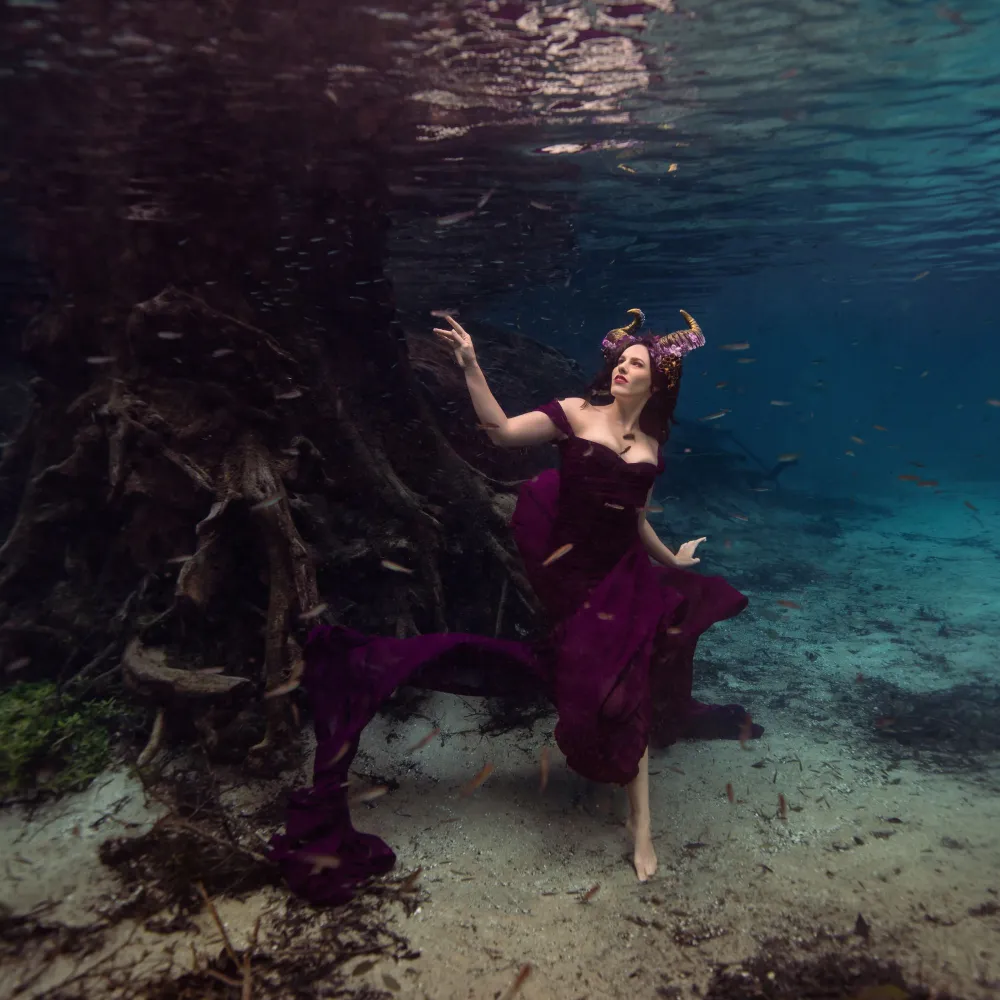
Most people see the final image...
The beautiful and ethereal float of fabric. The impossible stillness of a face beneath the surface. The way light fractures through water and turns an ordinary photograph into something cinematic.
What they don’t see are the hours of training behind that image. They don’t see the breath preparation, the physical conditioning, the communication between performer and photographer, or the concentration required to make stillness look effortless in an environment where your body is constantly moving.
Underwater modeling is much more than holding your breath and posing. It combines physical control, performance, movement, communication, and safety to create something that looks almost effortless on camera.
I’ve spent years working underwater as a model and performer, and I’ve learned that the best underwater images aren’t created simply by getting a model into a pool. They’re created when the person underwater understands how their body, the water, the camera, and the creative vision all work together.
These are some of the underwater modeling techniques and skills I’ve developed throughout my career.
What Makes Underwater Modeling Different?
Traditional modeling and underwater modeling share plenty of fundamentals: body awareness, facial expression, posing, and the ability to understand what a camera is seeing.
But the environment changes everything. Underwater, gravity behaves differently. Hair and fabric move independently. Your body is affected by buoyancy. Communication becomes primarily visual. Even a small movement can completely change the composition of an image.
And then there’s the breath. You aren’t simply standing still while someone takes your photograph. You’re performing while holding your breath, often while managing elaborate wardrobe, choreography, lighting, water movement, and a specific creative direction.
That combination is what makes underwater modeling techniques so important. The goal isn’t simply to survive being underwater, but to perform underwater.
Breath Control for Underwater Modeling
Breath control is one of the foundations of underwater performance. However, there’s an important distinction between having a long breath hold and being able to perform calmly underwater.
A person may be capable of holding their breath for an impressive amount of time, but that doesn’t automatically translate into beautiful underwater photography. If the performer is tense, rushing, uncomfortable, or focused entirely on getting back to the surface, the camera can often see it.
For me, the ability to remain calm underwater has always been just as important as the length of the breath hold.
My background in freediving and underwater performance has taught me to approach breath-hold work with preparation, awareness, and respect for my own limits. The goal is to remain relaxed enough to focus on the performance rather than treating every descent like a competition.
And that’s an important distinction. More time underwater isn’t automatically better. A professional approach means understanding your own limits and never turning a photoshoot into a test of how long you can stay underwater.
Anyone interested in learning freediving or developing breath-hold skills should seek appropriate instruction and follow established safety practices. Divers Alert Network: Freediving Safety and PADI Freediving offer educational resources on freediving training and safety
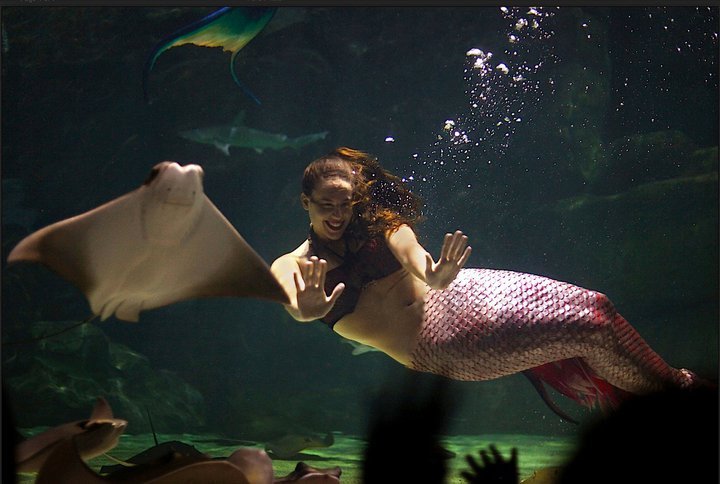
Underwater Movement Techniques: Making Gravity Disappear
This is where my background in dance became especially valuable.
Before I became an underwater performer, movement was already a huge part of my life. I was a dancer, and at one point I was even offered a place with a professional dance company. Ironically, I chose the underwater path.
I sometimes wonder what my life would have looked like if I had taken the dance opportunity, because I genuinely loved dancing. But looking back, I don’t regret the decision. But instead, I found a way to bring that movement language with me beneath the surface.
Underwater, dance became something entirely different. There is no floor to push against in the same way. Fabric floats and hair becomes part of the choreography. A simple turn can become a slow, suspended movement that would be impossible to recreate on land.
Some of the most useful underwater modeling techniques involve learning how to work with that environment rather than fighting it.
Neutral buoyancy
Understanding how your body behaves underwater allows you to maintain positions without constantly fighting to sink or float. Small changes in breathing, body position, and movement can affect where you are in the water column. That awareness gives an experienced underwater model much greater control.
Controlled movement
Underwater movement should rarely look forced. A movement that would take half a second on land might unfold over several seconds underwater. Learning to slow down without losing intention creates the graceful quality people associate with underwater photography.
Body lines
Every part of the body contributes to the image. An extended hand, pointed foot, curved back, or slight rotation of the head can dramatically change the feeling of a photograph. This is where a background in dance, gymnastics, diving, or other physical disciplines can become incredibly useful.
Working with fabric and hair
One of the magical things about underwater photography is that wardrobe becomes part of the movement. Fabric doesn’t simply hang, it floats. And hair doesn’t simply frame the face, but becomes another moving element within the composition.
An experienced underwater model learns to anticipate those movements and incorporate them into the performance.
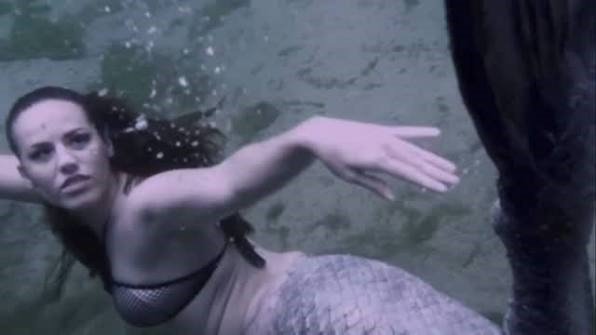
Communication During an Underwater Photoshoot
There’s another challenge that isn’t immediately obvious until you’ve actually worked underwater…You can’t talk.
Before a shoot begins, communication needs to happen on the surface. The photographer, model, safety team, and production crew should understand the creative plan and establish clear communication signals before anyone enters the water.
Once underwater, those signals become essential for everyone. Because not only can we not talk, but cannot see either… Everything is blurred while we are posing gracefully underwater. So that’s why everyone has to talk beforehand. Going over safety, shoot ideas, posing goals, etc.
The best underwater shoots I’ve experienced have involved a strong sense of communication and trust between everyone involved. The photographer isn’t just taking pictures, nor is performer just striking a pose. They’re working together to create the image.
That relationship becomes especially important when timing, movement, wardrobe, lighting, and breath holds all have to come together within a limited amount of time.
For more about preparing for the safety side of an underwater shoot, see my guide to Underwater Photoshoot Safety.
The Training Behind Professional Underwater Modeling
Beautiful underwater images can make the work look effortless. But trust me, it isn’t.
Underwater modeling training can involve physical conditioning, water confidence, breath awareness, movement practice, and extensive experience working in different underwater environments.
But technical training isn’t the only part. You also develop an understanding of how your body reacts underwater. You learn:
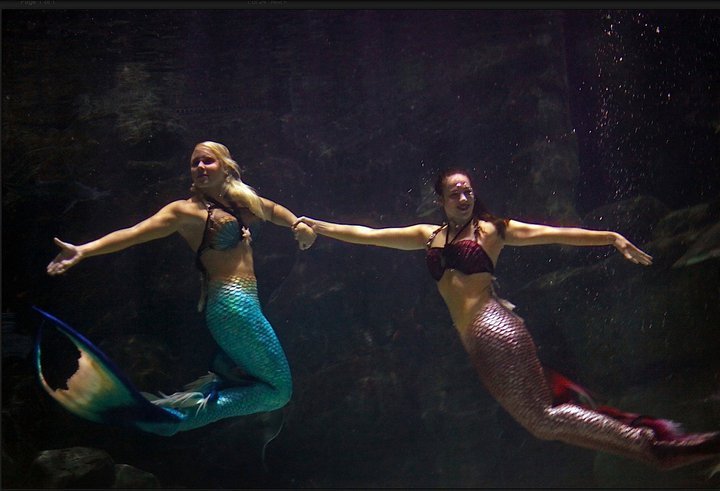
- How water temperature affects you.
- How different fabrics behave.
- How quickly a particular movement travels through the water.
- How to reset after a descent.
- To recognize when something doesn’t feel right.
That experience matters because an underwater photoshoot doesn’t always happen in perfect conditions…
Pools, open water, quarries, aquariums, and other environments can all behave very differently.
Underwater Modeling Safety Is Part of the Craft
No discussion of underwater modeling techniques would be complete without talking about safety.
Because here is the most important thing to remember: No image or footage should never be more important than the people creating it.
Professional underwater productions require thoughtful planning, appropriate supervision, communication, and an understanding of the specific environment.
For breath-hold work, appropriate safety support is essential. Established freediving safety guidance emphasizes formal training, close supervision, and avoiding breath-hold diving alone.
I also believe the production team should discuss the plan before anyone enters the water, including communication signals, environmental conditions, and what happens if something doesn’t go according to plan.
Safety isn’t something you add after the creative plan. It is part of the creative plan!
I’ve written more extensively about this in The Hidden Dangers of Being an Underwater Talent, as well as Underwater Photoshoot Safety: How to Prepare for a Successful Shoot.
Just remember that these aren’t details to figure out after the camera starts rolling… They’re and important part of the production.
What Photographers Should Know Before an Underwater Shoot
If you’re planning underwater photography, preparation on land can save enormous amounts of time in the water. A few things make a significant difference:
Have a creative plan.
Knowing the desired mood, composition, wardrobe, and movement before entering the water allows the team to use underwater time efficiently.
My article Underwater Modeling 101 goes into more detail about what models and production teams should consider before a shoot.
Understand the environment.
Water temperature, visibility, depth, lighting, current, and pool or location conditions can all affect the shoot.
Plan wardrobe carefully.
Some fabrics float beautifully. Others become heavy, restrictive, or visually uninteresting underwater.
Allow recovery time.
Underwater modeling isn’t simply an eight-hour standing pose.
Each descent requires recovery, preparation, communication, and resetting.
Give the performer something to perform.
Having a clear emotional direction is often more useful than simply saying, “Look beautiful” to your underwater talent.
- Should the image feel peaceful?
- Mysterious?
- Powerful?
- Playful?
- Dreamlike?
The more clearly the creative team communicates the story, the more the performer can bring that story to life!
What Makes an Experienced Underwater Model Different?

Experience underwater isn’t simply measured by how long someone can hold their breath. It’s measured by what they can do while they’re there.
- Can they maintain body awareness?
- Can they move intentionally?
- Can they understand how the camera sees them?
- Can they communicate without speaking?
- Can they work with wardrobe and props?
- Can they adapt when something changes?
- Can they perform emotion while managing the physical demands of the environment?
That’s ultimately what makes underwater modeling a specialized form of performance rather than simply a variation of traditional modeling.
The Art Behind the Technique
For all the technical preparation involved in underwater modeling, the technique isn’t really the reason I love this work. The water is.
There is a particular feeling I get when I descend beneath the surface and everything becomes quiet. The noise of the world fades, time slows, and I feel calm. And then, as I begin to move, something else happens.
The technical training disappears into the background and the performance takes over. That’s when underwater photography becomes more than a photograph or video. It becomes storytelling.
Whether the person looking at the finished image is five years old or ninety-five, I think there is something universally captivating about seeing a human being suspended beneath the surface.
Maybe it’s because we’re seeing something our everyday world doesn’t allow us to see. Maybe it’s the weightlessness, the mystery, or maybe it’s simply magic.
I’ve been fortunate enough to be part of the underwater performance world since its earlier days, before mermaid and underwater imagery became as widely popular as it is today. And I’m proud of that history.
But more than anything, I’m grateful that I found a way to combine performance, movement, water, and visual storytelling into something that still brings me joy.
Underwater Modeling Is More Than Looking Beautiful Beneath the Surface
The final photograph may look effortless, but the technique behind it isn’t.
Great underwater modeling combines breath awareness, movement, body control, communication, preparation, performance, and safety. And those skills allow a performer to stop thinking about simply staying underwater and start thinking about telling a story underwater. That’s the part I love the most!
I may be a voiceover artist first, but underwater performance will always be an important part of my creative identity. It has given me opportunities I never could have predicted, allowed me to work with incredible photographers and production teams, and taught me that sometimes the most unexpected career paths can lead somewhere extraordinary.
If you’d like to see examples of my work, explore my underwater modeling portfolio or learn more about working with me as a professional underwater model.
The surface is only part of the story.